How Much Does Forestry Mulching Cost in the Texas Hill Country?
Forestry mulching costs depend on more than acreage. Cedar density, terrain, access, equipment transport and fuel all affect the work involved.
If you own acreage in Bulverde, Boerne, Spring Branch, Canyon Lake, or the surrounding Texas Hill Country, you may be wondering what it costs to clear unwanted cedar, brush, or overgrown areas without completely stripping the land.
Forestry mulching can be an effective option, but pricing depends on much more than the number of acres. Here is what affects the cost, how projects are evaluated, and what to know before requesting an estimate.
Two Sons Outdoor Forestry Mulching Rate
$3,500 per full day, all-inclusive for the agreed daily mulching scope.
The daily rate includes equipment mobilization, loading and unloading, transportation to and from the jobsite, the machine and operator, diesel fuel, and normal equipment operating costs. These standard costs are built into the rate rather than added as separate routine transportation, mobilization, or fuel surcharges.
What Does Forestry Mulching Cost?
Our standard full-day forestry-mulching service is $3,500 per day for the agreed mulching scope. Not every property requires the same number of days, and acreage alone does not determine the final project price.
We assess vegetation, terrain, access, and the desired result before confirming scope and expected equipment time. Work outside the agreed forestry-mulching scope—such as grading, stump excavation, or hauling material away—requires a separate or expanded estimate.
Why Forestry Mulching Costs Vary
1. Cedar and brush density
A property with scattered cedar and light brush is very different from one covered in dense, mature cedar. Thicker vegetation requires more machine time. Tree diameter, spacing, and the amount of woody material also affect productivity.
2. Terrain and rocky ground
The Texas Hill Country presents its own challenges. Limestone outcrops, steep slopes, creek beds, uneven ground, and hidden rocks can affect equipment access and operating speed. Two properties of the same acreage can require substantially different amounts of work.
3. Equipment access
A mulching machine needs a safe route onto the property and enough working space. Narrow gates, fences, low branches, soft ground, and difficult approaches may require additional planning or preparation.
4. What you want to preserve
Not every land-clearing project should remove every tree. Many property owners want to retain mature oaks, selected cedar, desirable native vegetation, or screening along property boundaries. Selective clearing can require more careful equipment operation than clearing an open area.
5. The finished result
Are you cleaning up existing brush piles, improving access, opening views, preparing for a future homesite, or reclaiming heavily overgrown land? The desired outcome determines the amount of work required.
Forestry mulching generally processes vegetation into material left on the ground. Hauling material away, removing stumps, grading, and preparing a building pad are separate operations unless specifically included in the estimate.
6. Equipment mobilization, transportation, and setup
A forestry-mulching job starts before the machine begins cutting. Heavy equipment must be loaded and secured, transported to the property, unloaded, and positioned for work. At the end of the job, it must be loaded again and transported back.
For Two Sons Outdoor, those standard mobilization and transportation costs are already included in the $3,500 full-day rate. They are part of the economics of a professional forestry-mulching job even though not every minute is active cutting time.
7. Diesel fuel and operating costs
Both the mulching equipment and the trucks transporting it rely on diesel. Fuel is one operating expense alongside maintenance, cutting-tooth wear, insurance, and skilled operation.
Diesel prices can move with global oil supply, refining capacity, and transportation disruptions. When those costs change, the expense of delivering and operating heavy equipment changes as well. Our $3,500 daily rate already accounts for diesel and normal operating costs; we do not add a separate routine fuel surcharge.
That is one reason a current, property-specific estimate is more useful than relying on an old or universal per-acre price found online.
Is Forestry Mulching Priced by the Acre or by the Day?
Both approaches exist, but acreage alone is not always a reliable measure of the work involved. Two five-acre properties can have very different costs if one contains scattered small cedar and the other has dense woody growth, steep terrain, and limited access.
A daily equipment rate can provide a clearer starting point when productivity varies significantly across a property. Two Sons Outdoor's $3,500 full-day rate includes standard mobilization, transportation, loading and unloading, operator time, diesel, and normal equipment operating costs.
We do not promise a universal cost per acre or a fixed amount of acreage completed per day. The useful estimate is the one that defines the actual work area, vegetation conditions, equipment requirements, and expected result.
A Real Forestry-Mulching Project in Boerne
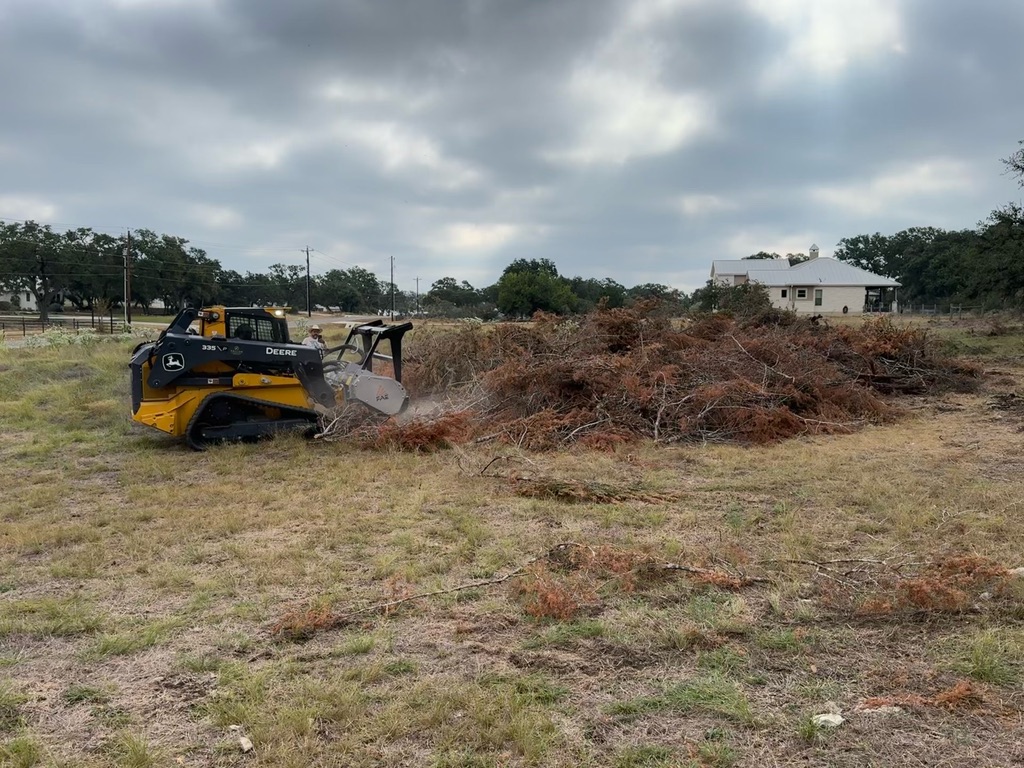
Two Sons Outdoor completed a cedar and brush cleanup project in Boerne, Kendall County. The property contained piles of previously cut cedar and brush on rocky Hill Country ground. The goal was to process that material, improve the appearance and usability of the land, and preserve selected existing trees.
Forestry mulching allowed the accumulated woody material to be processed on site, leaving a cleaner and more manageable area. See the authentic project photos and finished work in our Boerne Cedar & Brush Cleanup with Forestry Mulching case study.
When Is Forestry Mulching the Right Choice?
Forestry mulching may be a good fit when you want to:
- Reduce unwanted cedar and woody brush
- Process existing brush piles
- Reclaim overgrown areas
- Improve access and visibility
- Selectively open portions of a property while preserving desirable trees
- Prepare land for future improvements without immediately performing major earthwork
It is not necessarily the best method for every job. Properties needing stump excavation, extensive grading, major tree removal, or material hauling may require other clearing methods or additional equipment. For lighter grass and manageable saplings, acreage mowing or brush hogging may be more economical.
What Should You Provide When Requesting an Estimate?
A few details help us understand your project:
- Property location and approximate acreage
- Photos of the existing vegetation
- Areas you want cleared or preserved
- Gate and equipment-access information
- Your intended use for the property
- Any known obstacles, utilities, or site restrictions
When comparing estimates, check whether equipment delivery and return transportation, fuel, and operator time are included or charged separately. Those standard costs are included in Two Sons Outdoor's $3,500 full-day forestry-mulching rate. Additional work such as grading or hauling material away should be identified separately if needed.
Forestry Mulching in the Texas Hill Country
Two Sons Outdoor serves acreage and large-property owners throughout Bulverde, Boerne, Spring Branch, Canyon Lake, and surrounding communities.
Whether you are cleaning up cedar piles, reclaiming overgrown land, or preparing a property for future use, we can help evaluate the work and determine an appropriate approach.